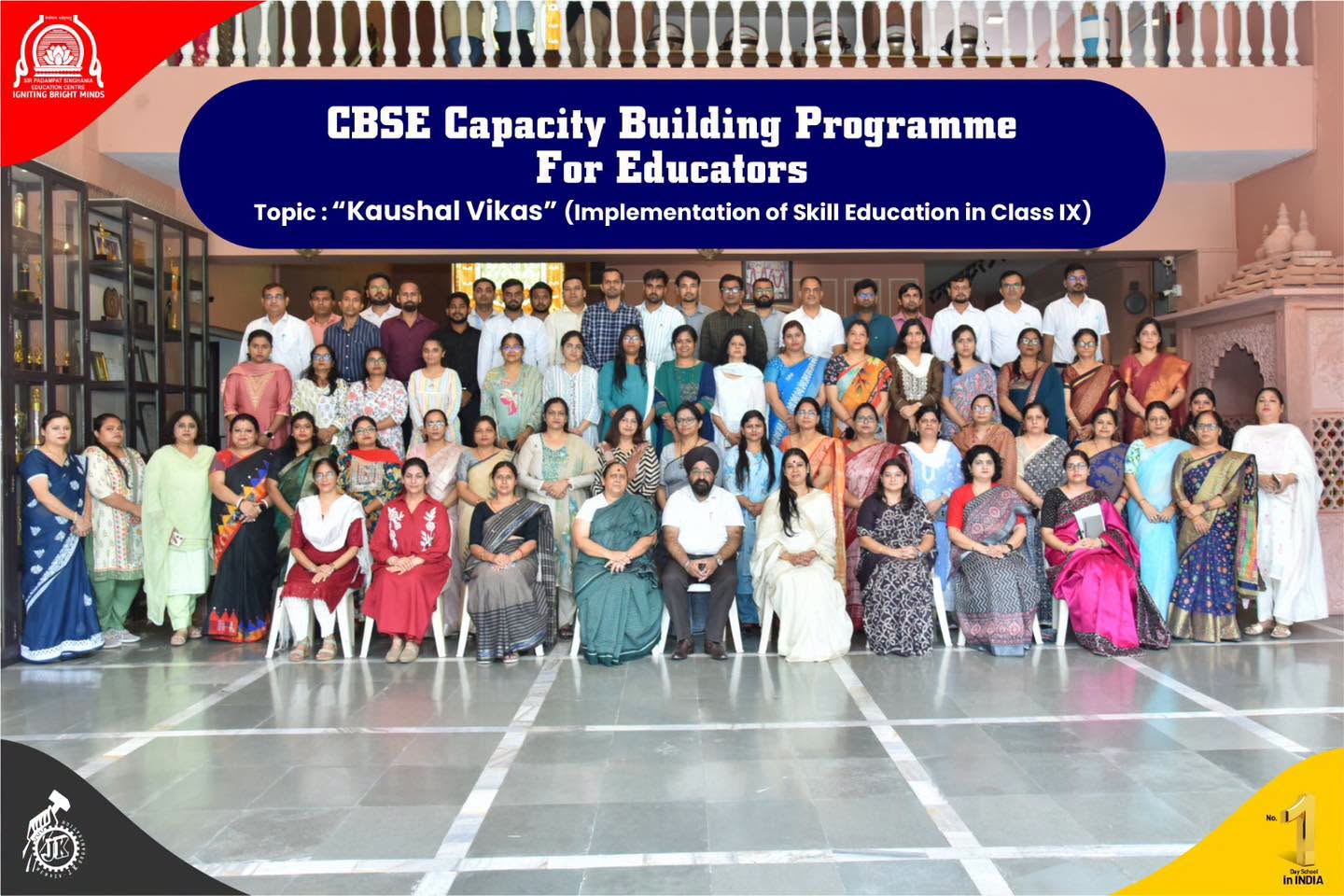
Quality education begins with empowered educators. As classrooms continue to evolve in response to the changing needs of learners, continuous professional development has become an essential part of effective teaching. Recognizing this, Sir Padampat Singhania Education Centre (SPSEC), Kanpur, proudly hosted a CBSE Capacity Building Programme for Educators on the theme “Kaushal Vikas” (Implementation of Skill Education in Class IX).
The programme was organized in alignment with the vision of National Education Policy (NEP) 2020 and the recommendations of National Curriculum Framework for School Education (NCF-SE) 2023, reinforcing the importance of integrating skill-based learning into school education.
Bringing together more than 60 educators from Kanpur, Lakhimpur Kheri, and Lucknow, the workshop became a valuable platform for collaboration, innovation, and professional growth.
Empowering Teachers for the Future of Education
Teachers play a central role in shaping the future of every learner. As education moves beyond traditional teaching methods, educators must continuously adapt to new pedagogies, technologies, and curriculum frameworks.
The CBSE Capacity Building Programme at SPSEC focused on equipping teachers with practical strategies to effectively implement Skill Education for Class IX, helping students become confident problem-solvers, critical thinkers, and lifelong learners.
The workshop emphasized that education should prepare students not only for examinations but also for real-life challenges and future careers.
Focus on “Kaushal Vikas”
The theme “Kaushal Vikas” reflects the growing emphasis on skill-based education in Indian schools.
Under NEP 2020, schools are encouraged to develop practical competencies alongside academic knowledge. Skill education enables students to apply classroom concepts to real-life situations while nurturing creativity, communication, collaboration, and innovation.
During the programme, educators explored approaches to:
- Integrate skill education into classroom teaching.
- Promote experiential and activity-based learning.
- Encourage critical thinking and problem-solving.
- Develop student confidence through practical applications.
- Connect academic concepts with everyday life.
- Foster career readiness from an early stage.
The discussions highlighted that meaningful education is achieved when knowledge is combined with practical skills and real-world experiences.
Guided by Distinguished Resource Persons
The success of the programme was enriched by the expertise of two highly respected education leaders.
Dr. Balwinder Singh
Principal, Guru Nanak Modern School
CBSE City Coordinator
Dr. Balwinder Singh shared valuable insights into the implementation of CBSE initiatives, innovative teaching practices, and the evolving role of educators in delivering skill-oriented education. His sessions encouraged teachers to embrace learner-centered methodologies that promote curiosity, participation, and deeper understanding.
Mrs. Hema Kalakoti
Principal, APS Academy, Lucknow
Mrs. Hema Kalakoti guided participants through practical approaches to implementing skill education within the classroom. Drawing from her extensive academic experience, she highlighted the importance of creating engaging learning environments where students actively participate, explore, and develop essential life skills.
Their combined expertise made the programme both informative and inspiring for every participant.
Learning Through Collaboration
One of the defining strengths of the CBSE Capacity Building Programme was the opportunity for educators from different schools and cities to come together and exchange ideas.
With participants representing Kanpur, Lakhimpur Kheri, and Lucknow, the workshop encouraged collaborative learning and professional dialogue.
Teachers discussed classroom challenges, shared successful teaching practices, and explored innovative ways to implement CBSE’s vision for skill-based education.
Such collaborative platforms strengthen the educational community by encouraging continuous improvement and mutual learning among educators.
Aligning with NEP 2020 and NCF-SE 2023
The programme reflected SPSEC’s commitment to implementing the transformative vision outlined in NEP 2020 and NCF-SE 2023.
These national frameworks advocate a shift from rote memorization to competency-based learning, emphasizing:
- Experiential learning.
- Skill development.
- Interdisciplinary education.
- Critical thinking.
- Creativity.
- Problem-solving.
- Student-centered pedagogy.
- Holistic development.
The workshop explored how these principles can be effectively integrated into classroom practices to create engaging and meaningful learning experiences for students.
By embracing these reforms, educators become catalysts for educational transformation.
Hands-On Professional Development
Rather than focusing solely on theoretical discussions, the programme emphasized practical learning through interactive activities and collaborative sessions.
Teachers participated in hands-on exercises designed to help them apply new ideas directly within their classrooms.
The workshop encouraged educators to rethink traditional instructional methods and adopt innovative approaches that make learning more engaging, relevant, and enjoyable for students.
Practical exposure ensures that professional development translates into improved classroom experiences and better student outcomes.
Strengthening the Culture of Continuous Learning
At SPSEC, learning is viewed as a lifelong journey for both students and educators.
Professional development programmes like this reinforce the belief that teachers who continue learning are better equipped to inspire curiosity, confidence, and excellence among their students.
Continuous learning enables educators to remain responsive to changing educational needs while creating classrooms that nurture independent thinking and innovation.
By investing in teacher development, SPSEC invests directly in the future success of every learner.
Building Skills for the Future
Today’s students require far more than subject knowledge.
They need adaptability, communication, creativity, collaboration, digital literacy, and problem-solving abilities to succeed in an increasingly dynamic world.
Skill education helps bridge the gap between academic learning and practical application by encouraging students to think critically and confidently.
The CBSE Capacity Building Programme equipped educators with strategies to cultivate these competencies within everyday classroom teaching.
This approach ensures that students develop both academic excellence and essential life skills.
SPSEC’s Commitment to Educational Excellence
Hosting the CBSE Capacity Building Programme reflects SPSEC’s ongoing commitment to maintaining the highest standards of educational quality.
The institution consistently provides opportunities for teachers to engage with educational experts, national curriculum initiatives, and innovative pedagogical practices.
Such initiatives strengthen the professional capabilities of educators while enriching the learning experiences of students across classrooms.
By fostering a culture of excellence among teachers, SPSEC continues to create an environment where innovation, collaboration, and continuous improvement remain central to education.
Shaping Tomorrow Through Teacher Empowerment
The CBSE Capacity Building Programme on “Kaushal Vikas” was more than a professional development workshop. It was a celebration of the vital role educators play in transforming lives.
With expert guidance from Dr. Balwinder Singh and Mrs. Hema Kalakoti, active participation from over 60 educators, and a strong focus on NEP 2020 and NCF-SE 2023, the programme successfully reinforced the importance of skill-based education in preparing students for the future.
As education continues to evolve, initiatives like these ensure that teachers remain empowered, inspired, and equipped to create meaningful learning experiences.
Through its dedication to teacher development and educational innovation, Sir Padampat Singhania Education Centre continues to strengthen its mission of empowering educators, nurturing future-ready learners, and shaping the leaders of tomorrow.